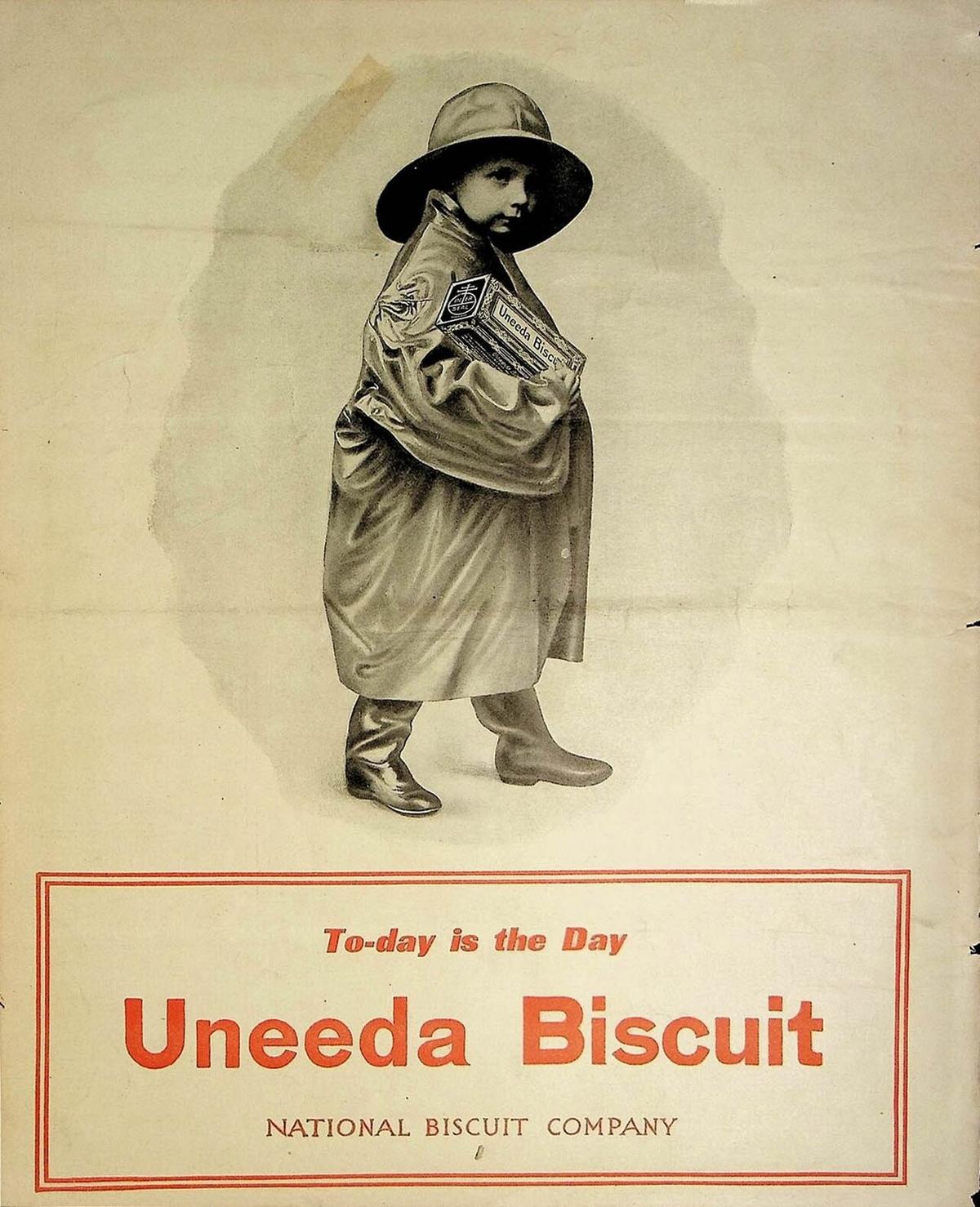
Uneeda Biscuit
Gone — Nabisco stopped baking Uneeda around 2009 without announcing it, and accounts differ by a year. The name survives mainly as ghost signs fading on the brick sides of old buildings.
Last verified Nov 14, 2026
The cracker was mostly an excuse for the box: Nabisco's wax-lined In-er-Seal carton ended the era of crackers scooped loose from a barrel. Sales passed a hundred million packages by 1900.
Filed under: Snacks & Chips · the ’70s & earlier
📜 The full story
In the 1890s crackers were sold loose from a barrel in the general store, by weight, and were often stale by the time anyone bought them. The National Biscuit Company was formed on February 3, 1898 by a merger that gave it 114 bakeries. The lawyer who had put it together, Adolphus Green, wanted one product that would be the same in every grocery in the country. He chose a soda cracker, lighter and flakier than the barrel kind and cut with eight sides.
The cracker mattered less than the box. Each carton held 21 crackers inside a liner of interfolded waxed paper and cardboard that the company called In-er-Seal, and it sold for five cents. That price left almost no profit on a box. Green was counting on volume. The red octagon around the In-er-Seal mark later grew into the Nabisco logo.
Green hired the Philadelphia agency N.W. Ayer & Son, which suggested the name. It was registered on December 27, 1898. In January 1899 a Chicago newspaper ran an ad that asked only whether the reader knew Uneeda Biscuit. More followed, on a budget of about $7 million over ten years, and thousands of brick walls were painted with the name. The company estimated that 30 million people saw a Uneeda ad every day. By 1900 it had sold more than 100 million packages.
The boy in the rain slicker arrived in 1900, by the company's account, standing in the rain with a dry box under his arm. Imitators arrived as well, with names like Iwanta, Uwanta and Ulika. The company took them to court and had won 249 infringement cases by 1906. Green ran the business until his death in 1917.
Uneeda stayed on shelves for more than a century, long after its sales had faded. Nabisco stopped making it without saying so. The Society for Commercial Archeology gives 2009 and Forgotten New York gives 2008, and neither records a reason beyond declining sales. What remains is paint. Faded Uneeda signs survive on walls on Staten Island and in several upstate New York cities, and each year there are fewer of them.
📅 Timeline
- 1898The National Biscuit Company was formed by merger on February 3, and its head Adolphus Green chose a soda cracker as the first product of a new packaged line. The Uneeda name was registered on December 27.
- 1899N.W. Ayer & Son, the agency that suggested the name, opened in January with a teaser ad in a Chicago newspaper that asked only, Do you know Uneeda Biscuit? A box of 21 crackers sold for five cents.
- 1900Uneeda sales had passed 100 million packages. By the company's own history, this was also the year the boy in the raincoat first appeared in its advertising.
- 1904A full-page Uneeda ad in The Saturday Evening Post carried little beyond the boy and the box.
- 1906The National Biscuit Company had by now won 249 trademark infringement cases, against imitators that included Iwanta, Uwanta and Ulika biscuits.
- 1917Adolphus Green died after leading the company for its first two decades.
- 1941The word Nabisco replaced the initials N.B.C. in the company's trademark.
- 2009Nabisco discontinued the Uneeda brand without a public announcement. Some accounts put the end in 2008.
- 2017A Uneeda wall sign in Schenectady, New York, uncovered the year before, was demolished with its building.
❓ People also ask
Why was the Uneeda Biscuit boy wearing a raincoat?
The rain slicker and galoshes were there to sell the package. The company's In-er-Seal carton had a waxed-paper liner that kept moisture out, and the boy was usually drawn in a downpour holding a dry box of crackers. An auction house that sold an original painting of him says the model was Gordon Stille, a five-year-old from Philadelphia and the nephew of an advertising man on the account.
Who came up with the name Uneeda?
The Philadelphia ad agency N.W. Ayer & Son suggested it. The campaign that followed cost about $7 million over ten years, and The Saturday Evening Post calls it the first to introduce a new product to the whole country. Adolphus Green called Uneeda the most valuable word in the English language.
When did Uneeda Biscuit come out?
The crackers went on sale in 1899, and the first teaser ad ran in Chicago that January. The name was registered on December 27, 1898, which is why some histories, including the current owner's, give 1898.
Can you still buy Uneeda Biscuits?
No. Nabisco dropped the brand in 2009 according to the Society for Commercial Archeology, or in 2008 according to Forgotten New York. No announcement or stated reason has been found; Forgotten New York says only that sales had declined.
Where can you still see Uneeda Biscuit signs?
Painted on old brick walls. The company had thousands of them put up, and survivors have been recorded in Stapleton on Staten Island and in Troy, Albany, Cohoes and Syracuse, New York, where one has been restored. They are disappearing. Schenectady lost three of its four in about a decade.
🧾 Sources
- Encyclopedia.com (International Directory of Company Histories), Nabisco Foods Group (1997)
- The Saturday Evening Post, Vintage Ads: Uneeda Biscuit Takes Crackers Out of the Barrel (2018)
- Society for Commercial Archeology, Do Uneeda Ghost? Hurry, They're Going Fast! (2018)
- Forgotten New York, UNEEDA BISCUIT, Stapleton (2014)
- Mondelez International, Our History
- Robert Edward Auctions, Circa 1900 Uneeda Biscuit Boy Original Painting (2007)